As healthcare costs continue to climb, businesses are increasingly looking for alternatives to the rigid, expensive structure of traditional group health insurance. The Individual Coverage Health Reimbursement Arrangement (ICHRA) has emerged as a powerful solution, offering employers budget control and employees more personalized choice.
While ICHRAs are a federal tool available in all 50 states, a new trend is accelerating their adoption: state-level financial incentives. As of April 2026, several states have moved to support this model by offering — or proposing — dedicated tax credits for ICHRAs.
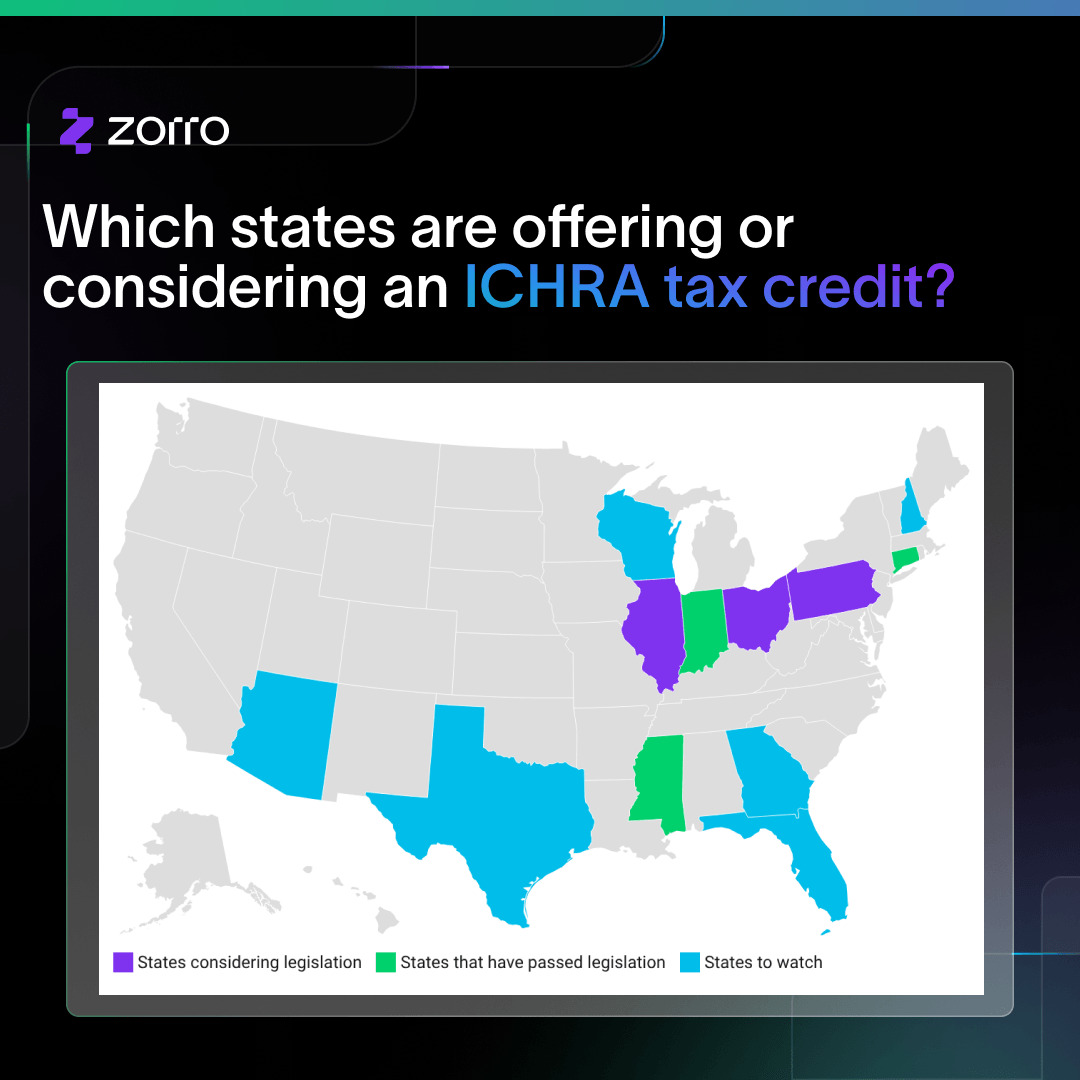
Which states currently offer ICHRA tax credits to employers?
Currently, three states (Indiana, Mississippi, and Connecticut) have officially enacted legislation that provides direct financial relief to small businesses that choose the ICHRA model over traditional group plans.
Indiana: The blueprint
Indiana was the first state to signal its support for the ICHRA revolution. In 2023, the state established the Indiana ICHRA tax credit (via HB 1004) specifically for employers with fewer than 50 employees.
This credit is more than just a one-time "thank you" from the state; it’s a strategic incentive designed to bridge the gap between traditional group plans and the individual market. In year one of your ICHRA, Indiana allows you to claim a credit of up to $400 per covered employee. In the second year, that "bonus" continues with a credit of up to $200 per employee. For a business with 25 employees, that's a potential $15,000 in total tax relief over two years just for modernizing your benefits.
One unique feature of the Indiana model is its "maintenance of effort" requirement. To qualify, you must contribute at least as much to the ICHRA as you previously spent on group health insurance premiums. If you’re a new business that has never offered benefits, don't worry — you still qualify! The state simply applies the credit to the first two years you offer an ICHRA (starting in 2024 or later). Plus, if your credit exceeds your tax liability for the year, Indiana allows you to carry that credit forward for up to 10 years, ensuring you actually get the full value of the incentive.
Mississippi: The Southern trailblazer
On April 6, 2026, Governor Tate Reeves signed HB 343 into law, making Mississippi the second state to enact a dedicated Mississippi ICHRA tax credit.
Under this law, employers with under 50 employees can claim a credit of up to $400 per covered employee in the first year and $200 in the second year.
There is a $1 million statewide annual cap, distributed on a first-come, first-served basis. So if you’re in the Magnolia State, the clock is officially ticking!
Connecticut: The high-value incentive
Connecticut officially joined the movement in May 2026, becoming the third state to enact a dedicated ICHRA tax credit (via Public Act 26-68).
The Nutmeg State is offering the most generous incentive to date. Eligible small businesses with 50 or fewer employees can claim a tax credit of up to $1,000 per covered employee per year for the first two years they offer an ICHRA.
The credit is capped at $5 million statewide annually and is awarded on a first-come, first-served basis, meaning employers in the state should act quickly to secure their savings.
How to access these state-level ICHRA tax credits
Finding out your state offers a credit is the fun part; actually claiming it requires a little bit of homework. If you’re a small business in Indiana or Mississippi, here is the general roadmap to securing your tax credits for ICHRAs:
- Verify your "small business" status: In all three states, these credits are currently reserved for employers with fewer than 50 full-time equivalent (FTE) employees.
- Document your "baseline" spend: To prevent businesses from using the credit to simply slash employee benefits, these laws often require you to maintain your contribution levels. Ensure you have clear records of what you paid for group insurance in the year prior to the switch.
- Use the correct tax codes: When it comes time to file, you’ll need to flag these specifically. For example, in the Hoosier State, you’ll report the Indiana ICHRA tax credit using Code 878 on Schedule IN-OCC.
- Mind the statewide cap: These programs are popular, but they aren't bottomless. Indiana has a $10 million annual cap, Mississippi’s is $1 million, and Connecticut's is $5 million. These are typically awarded based on the order in which returns are received, so filing early is your best friend.
- Work with a pro: Because these credits are nonrefundable but often carry forward, your CPA or tax advisor should be in the loop from day one to ensure you're maximizing the 10-year carry-forward provisions.
Which states are expected to begin offering ICHRA tax credits to employers in the future?
The momentum is not stopping with Indiana and Mississippi. Other states have active bills moving through their legislatures that could soon result in new ICHRA tax credits:
- Ohio (HB 133): The "one to watch." This bill passed the House with a unanimous 93-0 vote and is currently under Senate review. It is widely expected to be the next state to enact a tax credit.
- Illinois (SB 3619): Introduced in the spring of 2026, this bill proposes a tax credit mirroring the popular Indiana model, offering small employers up to $400 per covered employee in the first year and $200 in the second year.
Other states to watch
You may have heard buzz about other states like Wisconsin, Georgia, Florida, and Texas. While these states have shown high market interest, they are currently on our "Watch List" rather than our "Active" list for one specific reason: Legislative Calendar.
For a bill to be "moving," the legislature must be in session. In Wisconsin, for example, the 2025-26 session officially "gaveled out" in March 2026. While SB 1091 (which proposed a premium assistance credit) saw strong initial interest, it did not pass before the session adjourned. We saw similar outcomes this spring in Arizona (HB 2694) and New Hampshire (SB 635), where bills failed to advance before their respective legislative sessions concluded. This means these bills are effectively stalled until the next legislative cycle begins.
Similarly, sessions in Georgia and Florida concluded earlier this spring. While the interest from carriers and employers in these states is at an all-time high, we likely won't see these bills "move" again until 2027. Texas, which operates on a biennial schedule, is also in an "off-year" for its regular session in 2026.
What do state-by-state ICHRA tax credits mean for larger employers?
If you are an employer with more than 50 employees, you might notice that these specific tax credits for ICHRAs are currently targeted at the "small business" market. However, this legislative momentum is actually a major strategic win for larger organizations as well.
→ This signals market stability and carrier competition. When states offer tax credits to small businesses, they are effectively "seeding" the individual insurance market with thousands of new participants. For a large employer (ALE) using an ICHRA, a healthy individual market is essential. More participants lead to increased carrier competition, broader provider networks, and more stable premium rates — benefits that directly impact the ROI of a large-scale ICHRA program.
→ It reinforces ACA Compliance and "Proof of Concept"
Large employers are already using ICHRAs at record rates because they effectively satisfy the ACA employer mandate. The fact that states are now codifying and incentivizing this model provides "peace of mind" and regulatory certainty for HR leaders at larger firms who are looking for a long-term alternative to traditional group renewals.
Above all, the state-offered tax credits signal that ICHRA is here to stay.
Whether you are a small business looking to claim a specific ICHRA tax credit or a large employer looking to leverage a more competitive individual market, the message from state capitols is clear: the future of health benefits is flexible.
Keep in mind that you don’t need a state tax credit to start saving with an ICHRA today — the model is already designed to provide budget predictability and employee choice. But if you are in a state with an active or pending credit, these incentives make the transition more affordable than ever.